 OFFICIAL SITE OF THE STATE OF NEW JERSEY
Radon
The Radon Section conducts outreach activities to educate the public on the risks of radon and how homes can be fixed. Staff work with municipal governments to promote public awareness. By law, all businesses and professionals conducting radon testing and mitigation in New Jersey must be certified by the DEP. The Radon Section regulates radon measurement and mitigation businesses and professionals to ensure high quality radon services.
Student Section
For information regarding the poster contest, classroom resources and student resources
Radon Resources for Homeowners
Radon Info & Testing
How to test and mitigate radon
Radon & Real Estate
For home buyers and real estate professionals
Testing Water in Private Wells
The NJ Highlands area is most at risk for naturally occurring radioactive substances in groundwater
Look up Your Municipality's Radon Potential
NJ Municipalities are classified by three levels of radon risk
Certification for Radon Businesses
What is Radon?
Radon is a radioactive gas that comes from the breakdown of naturally occurring uranium in soil and rock. It is invisible, odorless and tasteless, and can only be detected by specialized tests. Radon enters homes through openings that are in contact with the ground, such as cracks in the foundation, small openings around pipes, and sump pits.
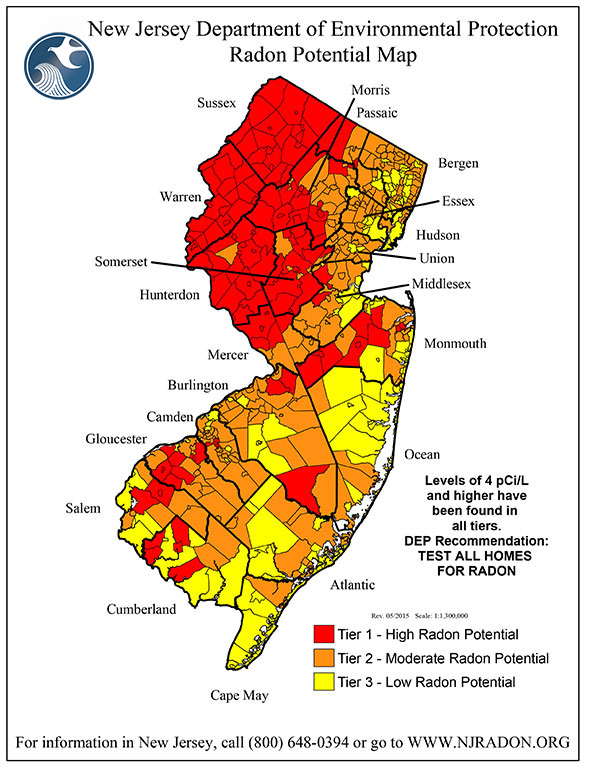
The Radon Potential Map presents radon testing data to show the potential for elevated radon concentrations in each New Jersey municipality with tier area assignments of risk. While this type of visual tool is helpful to determine if you live in an area where radon is more likely to be found, DEP recommends that all homes be tested for radon. Radon concentration can vary widely even within a tier location, depending upon the geology and amount of uranium in the soil. This means that homes in low or moderate radon potential areas may still have elevated radon concentrations. The DEP and the U.S. Environmental Protection Agency both recommend that you mitigate your home if your test results indicate radon levels of 4 picocuries per liter (pCi/L) of radon or higher.
Radon Causes Lung Cancer
Radon is the leading cause of lung cancer among non-smokers, according to the U.S. Environmental Protection Agency. Overall, radon is the second leading cause of lung cancer. The more radon you are exposed to, and the longer the exposure, the greater the risk of eventually developing lung cancer. Radon is responsible for about 21,000 lung cancer deaths every year in the United States. About 2,900 of these deaths occur among people who have never smoked.
Radon Potential Map
Outreach
The Radon Section attends various conventions throughout the year, hosts poster contests and speaks at schools and businesses.
January Proclaimed as Radon Action Month
The best time to test for radon is during the heating season, so January is the perfect time. Coinciding with a national initiative dedicated to promoting radon awareness, testing and mitigation, and radon resistant new construction. Check with your municipal or county health department for free radon test kits or purchase a test kit from a hardware store or a NJ certified radon business.