 OFFICIAL SITE OF THE STATE OF NEW JERSEY
How to Test Your Home for Radon
DIY Test Kits
Buy at hardware stores, local health departments, or online. Make retail kits have the New Jersey certification number (starting with “MEB9”).
Hire a Professional
Businesses can come to your home to test and some businesses also have an option to mail radon devices to homeowners.
Radon FAQ for Homeowners
Radon is a radioactive gas that comes from the breakdown of uranium found in soil and rock. It’s invisible, odorless, and tasteless, so special tests are needed to detect it. Radon can enter homes through cracks in the foundation, gaps around pipes, water supplies, and sump pits. Radon, like other radioactive materials, undergoes radioactive decay that forms decay products. Radon and its decay products release radioactive energy that can damage lung tissue.
Radon is the leading cause of lung cancer among non-smokers, according to the U.S. Environmental Protection Agency. Overall, radon is the second leading cause of lung cancer. The more radon you are exposed to, and the longer the exposure, the greater the risk of eventually developing lung cancer. Radon is responsible for about 21,000 lung cancer deaths every year in the United States. About 2,900 of these deaths occur among people who have never smoked.
Radon Risk for Smokers
| Radon Level | If 1,000 people who smoked were exposed to this level over a lifetime*… | The risk of cancer from radon exposure compares to**… | WHAT TO DO: Stop smoking and… |
|---|---|---|---|
| 20 pCi/L (740 Bq/m3) | About 260 people could get lung cancer | 250 times the risk of drowning | Fix your home |
| 10 pCi/L (370 Bq/m3) | About 150 people could get lung cancer | 200 times the risk of dying in a home fire | Fix your home |
| 8 pCi/L (300 Bq/m3) | About 120 people could get lung cancer | 30 times the risk of dying in a fall | Fix your home |
| 4 pCi/L (150 Bq/m3) | About 62 people could get lung cancer | 5 times the risk of dying in a car crash | Fix your home |
| 2 pCi/L(75 Bq/m3) | About 32 people could get lung cancer | 6 times the risk of dying from poison | Consider fixing between 2 and 4 pCi/L (75-150 Bq/m3) |
| 1.3 pCi/L (50 Bq/m3) | About 20 people could get lung cancer | (Average indoor radon level) | (Reducing radon levels below 2 pCi/L (75 Bq/m3) is difficult.) |
| 0.4 pCi/L (15 Bq/m3) | About 3 people could get lung cancer | (Average outdoor radon level) | |
| Note: If you are a former smoker, your risk may be lower. * Lifetime risk of lung cancer deaths from EPA Assessment of Risks from Radon in Homes (EPA 402-R-03-003). ** Comparison data calculated using the Centers for Disease Control and Prevention’s 1999-2001 National Center for Injury Prevention and Control Reports. |
|||
Radon Risk If You Have Never Smoked
| Radon Level | If 1,000 people who never smoked were exposed to this level over a lifetime*… | The risk of cancer from radon exposure compares to**… | WHAT TO DO: |
|---|---|---|---|
| 20 pCi/L (740 Bq/m3) | About 36 people could get lung cancer | 35 times the risk of drowning | Fix your home |
| 10 pCi/L (370 Bq/m3) | About 18 people could get lung cancer | 20 times the risk of dying in a home fire | Fix your home |
| 8 pCi/L (300 Bq/m3) | About 15 people could get lung cancer | 4 times the risk of dying in a fall | Fix your home |
| 4 pCi/L (150 Bq/m3) | About 7 people could get lung cancer | The risk of dying in a car crash | Fix your home |
| 2 pCi/L (75 Bq/m3) | About 4 person could get lung cancer | The risk of dying from poison | Consider fixing between 2 and 4 pCi/L (75-150 Bq/m3) |
| 1.3 pCi/L (50 Bq/m3) | About 2 people could get lung cancer | (Average indoor radon level) | (Reducing radon levels below 2 pCi/L (75 Bq/m3) is difficult.) |
| 0.4 pCi/L (15 Bq/m3) | (Average outdoor radon level) | ||
| Note: If you are a former smoker, your risk may be higher. * Lifetime risk of lung cancer deaths from EPA Assessment of Risks from Radon in Homes (EPA 402-R-03-003). ** Comparison data calculated using the Centers for Disease Control and Prevention’s 1999-2001 National Center for Injury Prevention and Control Reports. |
|||
from “A Citizen’s Guide to Radon: The Guide to Protecting Yourself and Your Family From Radon”
Testing your home for radon is simple. You can use a “do-it-yourself” test kit or hire a certified radon measurement company. Test kits are available at hardware stores, local health departments, or online. If you choose a retail test kit, make sure it has a New Jersey certification number (starting with “MEB9”). You can also call the Radon Section at 800-648-0394 for certified company information.
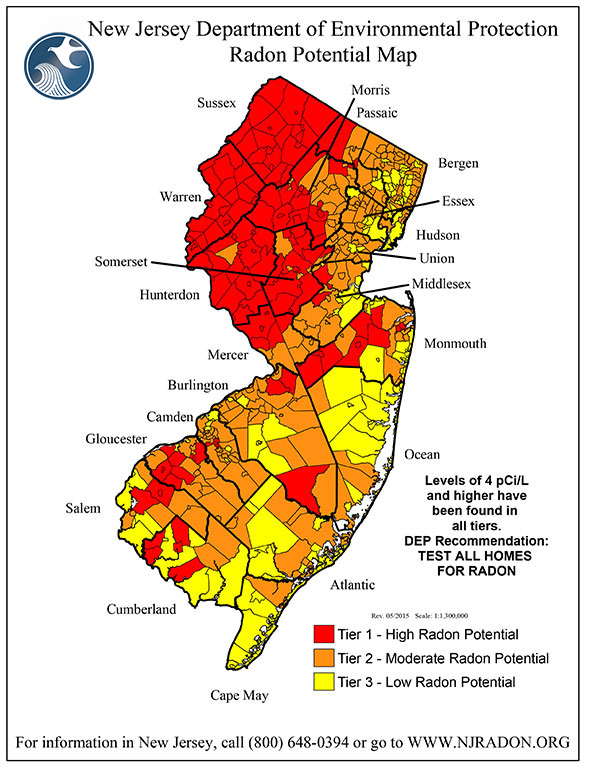
Radon levels can vary widely, even within the same neighborhood. High levels can occur anywhere in the state, so testing every home is recommended. Radon remediation systems have successfully reduced indoor levels significantly, often below 1 pCi/L, even in homes with initially high levels.
The most common solution is installing a sub-slab depressurization system. This system uses a pipe to vent radon from under the basement to above the roof, where it disperses safely. Cracks and openings in the foundation are sealed as part of the process. The cost of such a system ranges from $750 to $3,500, depending on the home.
MITIGATE RADON
Hire a NJ certified radon mitigation professional to reduce radon levels in your home.
REAL ESTATE & RADON
Radon information for real estate professionals and home buyers when selling or purchasing a home.
WATER TESTING
The NJ Highlands area is most at risk for naturally occurring radioactive substances in groundwater.